
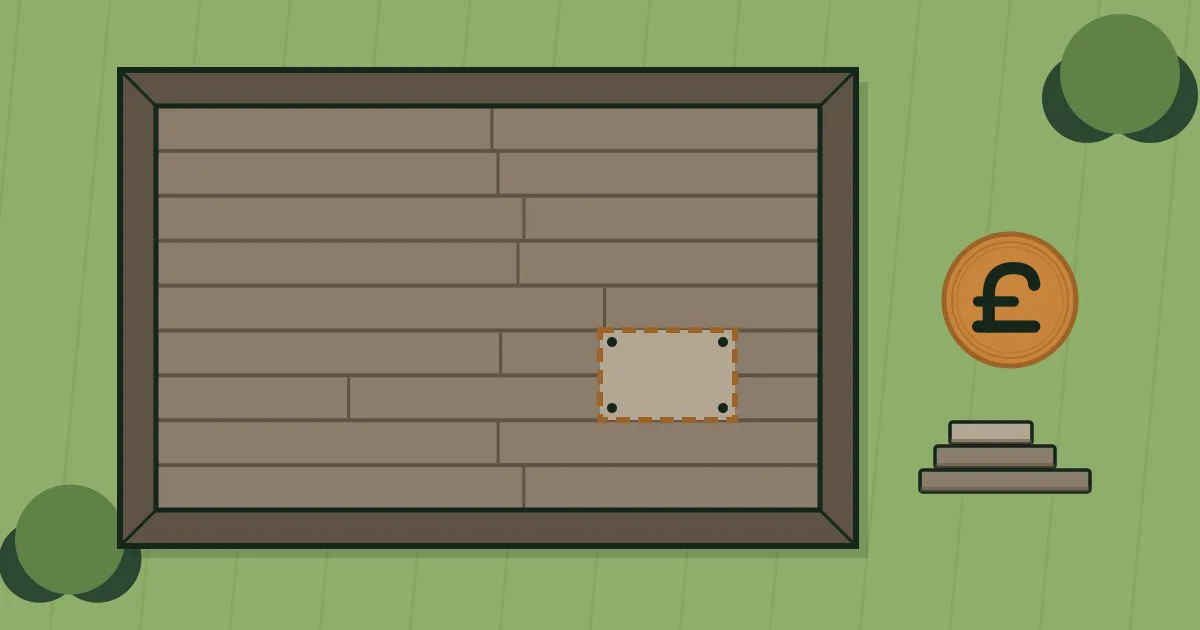
For a composite deck supplied and fitted, the range we publish is £2,800–£8,500. That figure sits on our composite decking installation page and covers a complete domestic job: setting out, ground preparation, the supporting frame, the boards, their fixings and the trims that finish the edges.
Most people expect the board range to decide where in that bracket their deck lands. It matters, but it is rarely the whole story. Two decks with identical floor area and identical boards can be priced a long way apart because of how the boards are laid out: how many full lengths fit without waste, whether a border runs round the edge, whether the boards run on a diagonal, and how many joins need their own support underneath.
Fitted prices at three levels
Indicative fitted composite decking prices (supply and installation, as a guide)
| Level | Fitted price | Layout and scope at this level |
|---|---|---|
| Simple layout | £2,800–£4,700 | A compact rectangle sized around full board lengths, a standard board range, straight runs and a plain fascia |
| Bordered layout | £4,700–£6,600 | A larger area with a picture-frame border, an access hatch, one step and matching trims on the exposed edges |
| Detailed layout | £6,600–£8,500+ | A shaped or diagonal design, a premium capped range, aluminium supports and several steps or level changes |
The top figure is not a ceiling. A deck that needs to be raised well above the ground is a different kind of structure and is priced separately; see our raised decking cost guide. If you are weighing composite against wood, the timber decking cost guide uses the same three-level approach so the two can be compared side by side.
A sketch showing board direction, border, joins and hatch positions tells you more about a quote than the headline total. If two firms have drawn different layouts, they are pricing different decks.
Why the layout moves the price
Board lengths and offcuts
Composite boards come in fixed lengths. If the deck is a few centimetres longer than one board, every row needs a second piece and most of that second board may end up as waste. Installers try to set the footprint so rows use full lengths or split neatly, and a homeowner who is flexible on exact size can sometimes save a noticeable amount of material. Ask how many packs have been allowed for and what proportion is expected to be offcut.
Joins that need support
Where two board ends meet in the middle of a run, the manufacturer usually specifies how that butt joint is supported, often with a doubled joist or a set detail. More joins mean more framing and more cutting time. Staggered joins look better but can increase the amount of frame needed, so this is a trade-off worth discussing rather than assuming.
Picture-frame borders
A border hides cut board ends and gives a tidy finish, which is why it is popular. It also runs across the main boards, so it needs its own supports beneath, mitred or butted corners and extra boards. On a small deck, a border can use more boards than people expect.
Diagonals and shapes
Boards laid on a diagonal, or a deck with angled or curved edges, use more material and take longer to cut and fix. The frame often needs closer or angled supports too. The result can look striking, but the extra cost buys appearance rather than space: the seating area is no larger.
Hatches, trims and steps
If a drain cover, stopcock or inspection chamber falls under the deck, it needs a removable panel with its own framing. Hollow boards need end caps or a fascia, and each step needs trims to match. These items are small individually but they add up, so check each one appears on the quote.
Board range and frame material
Capped boards, with a protective outer layer, generally cost more than uncapped ones. The frame beneath may be treated timber or aluminium; aluminium usually costs more. Whichever is used, it has to suit the spacing and fixing rules for the board range chosen, which is why changing range after a quote has been issued can change the frame as well as the board price.
Clips, screws and mixing brands
A common way to trim a quote is to suggest cheaper fixings. With composite this is risky. Clip shapes, screw types and the gaps a board needs to expand and contract in warm weather differ between ranges, and a fixing designed for one product may not hold another properly. Using fixings the board maker does not approve can also affect the warranty. Expect the installer to use the system specified for your boards, or an alternative the manufacturer accepts, and to price it on that basis.
Reading two quotes side by side
- Is the named board range the same on both, including colour and capped or uncapped?
- Has each firm drawn the same footprint, border and board direction?
- Are steps, fascia, end caps and hatches listed, or only implied?
- What is the deck sitting on, and is the frame material stated?
- Is removal of anything already on the footprint included, and is waste disposal priced?
- Is VAT shown, and are delivery and any access charges separate?
If you are still deciding between materials, our composite vs timber decking guide compares upkeep, heat, grip and how each ages. For a quick budget figure before you ask anyone round, try the decking cost calculator.
When you are ready, send one enquiry and up to four independent installers may get in touch to price your deck. There is no obligation to accept any of them.
Frequently asked questions
Is composite decking priced per square metre?
Some suppliers quote board prices that way, but a fitted price depends on more than area. Layout, borders, steps, the frame and access all affect labour and material, so we publish whole-job ranges rather than a per-metre rate.
Does a picture-frame border cost much more?
It usually adds boards, supports and cutting time, which matters most on a small deck. Ask each installer to show the border on its own line; then you can judge whether the finish is worth it.
Can I make the deck cheaper by changing its size slightly?
Often, yes. Setting the length and width so the boards fit with little waste can reduce material, and a simpler shape cuts labour. Ask the installer which dimensions suit the board range you have chosen.
Why did my quote change when I picked a different board range?
Different ranges have different fixing systems, gap requirements and support rules. A change of range can therefore change the frame and fixings as well as the board price.
Ready to talk to a composite decking specialist?
Get Free Quotes →