
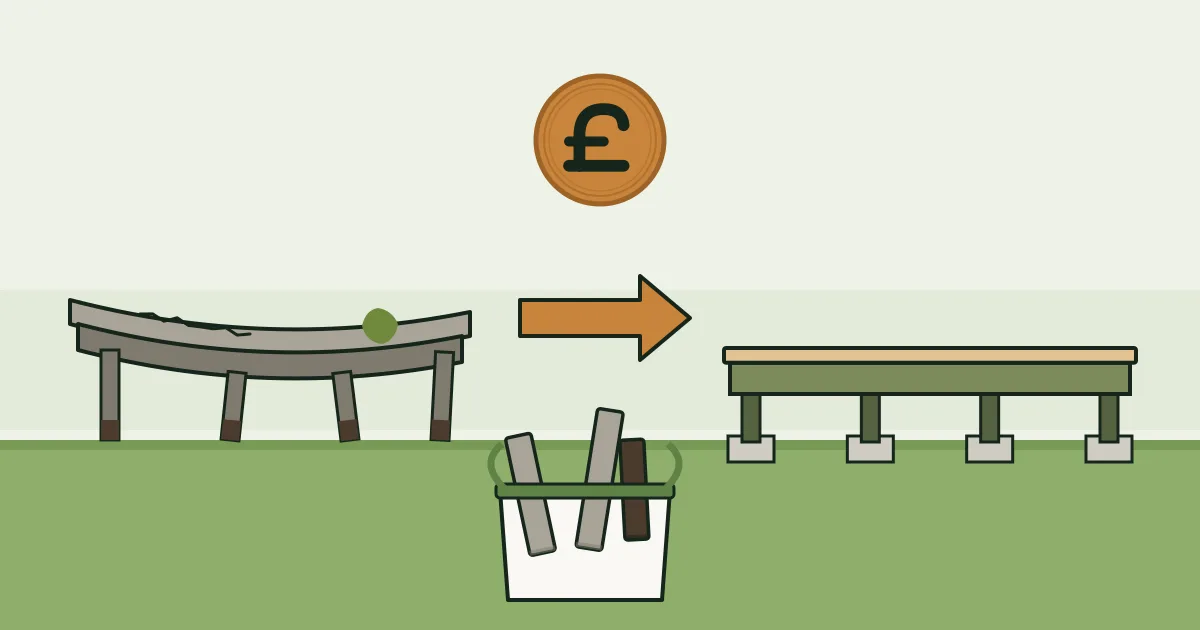
Our indicative range for decking replacement is £2,000–£7,500. That covers dismantling an old deck, getting rid of the waste and rebuilding: anything from new boards on a frame that has been checked and kept, to a complete strip-out and fresh structure.
The single biggest question in any replacement is how much of the old deck is still worth relying on. That is also the hardest thing to know before work starts, because most of a frame cannot be seen until the boards come up. Good quotes handle that uncertainty openly rather than hiding it.
Replacement prices by how much is rebuilt
Indicative decking replacement costs, including removal (as a guide)
| Scope | Guide cost | Typical work |
|---|---|---|
| New surface, frame kept | £2,000–£3,800 | Old boards removed and new ones fitted on a frame that has been inspected and found suitable, same footprint |
| Full strip-out and rebuild | £3,800–£5,700 | Boards and frame removed, new frame and boards on the same footprint, disposal of the old materials included |
| Rebuild with changes | £5,700–£7,500+ | A new frame plus a change of size, height or material such as premium composite, or hidden concrete or poor ground to deal with |
If you only want the old deck taken away, our free quotes page gives £150–£400 as an allowance for removing and disposing of a small, accessible timber deck. Do not add that figure on top of a replacement quote that already includes removal; check the wording.
Treat a replacement as strip-out first, rebuild second. Agree how the frame will be recorded once it is exposed, what the first price assumes, and how any extra work will be approved before it goes ahead.
Stage one: taking the old deck apart
Dismantling looks simple but takes time. Old fixings may be rusted in, boards may break as they come up, and everything has to be carried out of the garden. If every load of waste must be carried through the house, expect protection for floors and more trips. Disposal is charged by volume, so a large deck or one with a lot of frame adds up.
Stage two: deciding what stays
Once the boards are off, the installer can see the joists, bearers and supports. Keeping them is the biggest saving a replacement can offer, but only if they are sound, level, spaced correctly for the new boards and well connected. A frame built for one board type may not suit another: composite boards, for example, often need supports at different spacing from the timber boards they replace.
If a firm offers a board-only price, ask why it believes the frame can stay. "It looks fine from above" is not an inspection. A sensible quote either states what will be checked once the boards are up, or prices both outcomes.
Stage three: the rebuild
From here, the cost follows the same drivers as a new deck: board choice, layout, steps and edges. Replacement is also a chance to fix things the original builder got wrong. That might mean opening up blocked air bricks, adding an access hatch over a drain, or moving a step that always felt awkward.
Changes have consequences, though. Raising the deck, enlarging it or moving the stairs can change whether planning permission or building control is needed, and following the old outline does not prove the original deck was ever approved. Check before you commit to a bigger or higher design.
What pushes a replacement over budget
- More rot than expected, once the boards come up
- Concrete pads or old paving under the deck that have to be broken out
- Soft or poorly drained ground that needs work before new supports go in
- Waste carried through the house or along a long, narrow passage
- A switch to a premium board range or a larger, higher deck
Not sure your deck needs replacing at all? Work through repair, restore or replace to tell a full rebuild from a smaller job, and the decking repair cost guide shows what targeted repairs cost. For a quick budget, try the decking cost calculator.
When you are ready, send an enquiry and ask responding installers to price both a repair and a replacement if you are unsure which you need.
Frequently asked questions
Do all the old joists have to come out?
Not necessarily. Joists can stay if an inspection shows they are sound, level, correctly spaced for the new boards and well connected. Any saving should be based on that inspection, not on a view from above.
What if the installer finds more rot halfway through?
They should stop, show you what they have found and agree a revised price before going further. Ask for that process to be written into the quote.
Is removing the old deck included in a replacement quote?
Usually, but check. Dismantling, carrying waste out and disposal should each be visible in the scope.
Can I put composite boards on my old timber frame?
Sometimes, but composite ranges have their own support and fixing rules, so the existing frame may not suit them even if it is sound. The installer should check it against the board maker's requirements.
Ready to talk to a decking replacement specialist?
Get Free Quotes →