
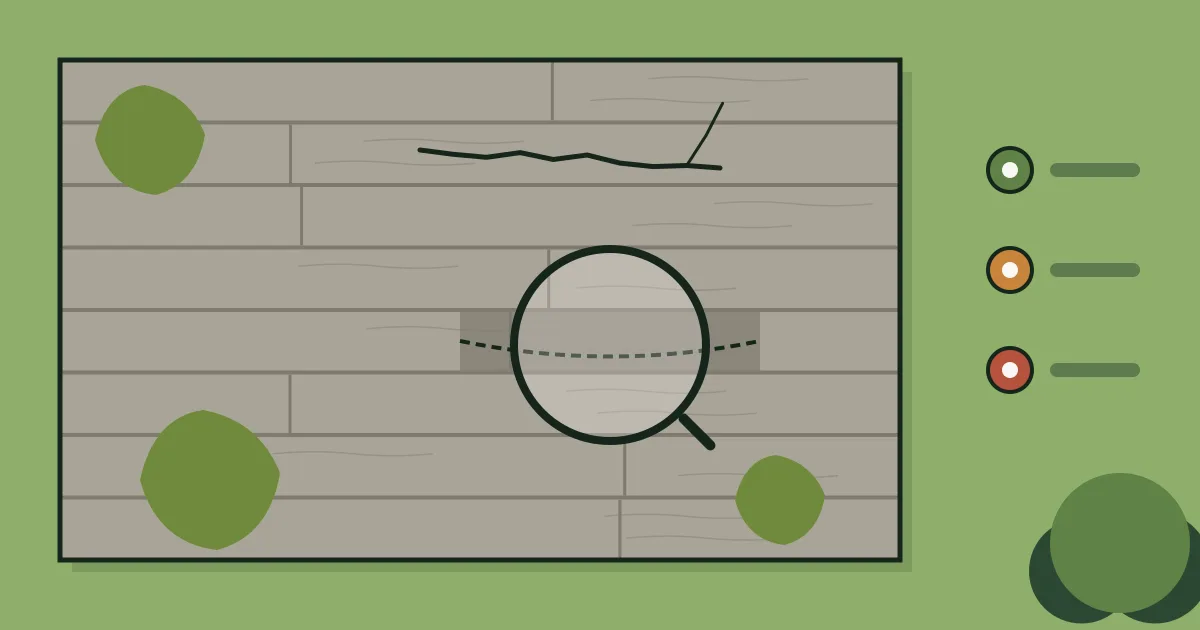
An old deck that looks bad is not always a deck that needs replacing. Many tired decks only need a proper clean. Others have one or two faults a carpenter can fix in an afternoon. A smaller number have a frame that is past saving, and spending on the surface would be wasted money.
This guide sorts what you might be seeing into three groups, each pointing to a different service. Start with the safety check, then find the signs that match your deck.
Do not bounce on a soft area, lean on a loose rail or climb under a raised deck to look. Note what you see from safe ground and from the firm parts of the deck, take photographs, and keep everyone off anything that moves.
Group 1: the deck is sound but tired
If the whole deck feels firm underfoot, steps do not move and rails are solid, what you are seeing is probably on the surface:
- Green or black growth, especially in shady corners or under pots
- Boards that are slippery after rain
- Timber turned grey, or a stain worn patchy or peeling
- Leaves and soil packed into the gaps
- Marks from food, barbecues or planters
These point to decking cleaning and restoration, usually the cheapest fix; see the restoration cost guide. One warning: a clean colour does not prove a board or joist is sound. A good contractor will mention anything worrying they spot while cleaning.
Group 2: local faults on a deck that is otherwise firm
If problems are confined to one area and the rest of the deck feels solid, a targeted repair is usually the right answer:
- A few boards split, soft at the ends or lifting at the fixings
- One section that dips while everything around it is firm
- A step that rocks or a tread that has come loose
- A handrail or balustrade that has started to move
These point to decking repairs; the repair cost guide shows typical prices. The repair should find out why the part failed. If a soft board sits over a rotting joist, the joist is the real job. A loose rail needs keeping clear of until someone has checked what it is fixed to.
Group 3: signs the deck needs replacing
Replacement becomes the sensible choice when the problems are no longer local:
- Soft or springy areas in several places rather than one
- New soft spots keep appearing after earlier repairs
- Joists or bearers you can see are dark, crumbly or split
- Posts move, lean or have rotted at ground level
- The deck sits over air bricks or above the damp-proof course, or blocks access to a drain
- Water pools against the house or in a corner because of how the deck was built
- The layout no longer works: an awkward step, a cramped seating area or a stair in the wrong place
- You want to switch from timber to composite, which may need a different frame
These point to decking replacement. It can mean new boards on a frame that has been checked and kept, or a complete rebuild; our decking replacement cost guide explains how the price depends on what can stay.
Raised decks: lower the threshold
On a deck well above the ground, the consequences of failure are more serious. Treat any movement in posts, bracing or guarding as a reason to stop using that area and get it inspected, even if the boards look fine. A raised deck with several of the Group 3 signs usually needs a new structure, often designed alongside a new stair and balustrade.
Still not sure?
You do not have to diagnose the deck yourself. When you ask for quotes, describe what you have seen and ask contractors to price both a repair and a replacement. Hidden damage may mean neither can be fixed firmly until boards are lifted, so expect some quotes to include an inspection stage. If you are thinking of buying a house with an existing deck, our guide to buying a house with decking covers what to look for before you commit.
Describe your deck in one enquiry and up to four local specialists may respond.
How to check an old deck safely
- Clear the surface
Move furniture and pots and sweep the boards and gaps so you can see the surface properly.
- Walk the firm areas carefully
Walk slowly over the parts you know are solid, noting any boards that flex, creak or dip. Step back immediately if anything feels soft.
- Look at board ends and fixings
Check where boards meet and around screws for softness, dark staining, splits or fixings that have lifted.
- Check steps and rails from the side
Look for rocking treads, gaps at connections and posts that lean. Do not put weight on a rail to test it.
- Look underneath from outside
If you can see the frame from the edge without crawling underneath, look for dark, crumbly or split timber and posts rotted at ground level.
- Check the house junction
Note whether the deck covers air bricks, sits near or above the damp-proof course, or traps water against the wall.
- Photograph and decide
Photograph each issue and sort them into surface, local or widespread. Use that to decide whether to ask for cleaning, repair or replacement quotes.
Frequently asked questions
How long does decking usually last?
It varies too much to give a reliable figure. The quality and treatment of the frame, ventilation, drainage, shade and upkeep matter more than age alone. Judge your deck by its condition, not its birthday.
Can I replace the boards and keep the frame?
Sometimes. The frame needs inspecting once the boards are off to confirm it is sound, level and suitably spaced for the new boards. Any saving should be based on that inspection.
Is a slippery deck a sign it needs replacing?
Usually not. Slipperiness is normally caused by algae, dirt or poor drainage, which cleaning can deal with. It only points to replacement if the boards are also soft or the deck holds water because of how it was built.
Should I ask for repair and replacement prices together?
Yes, if you are unsure. Contractors can show what a targeted repair would keep and what a rebuild would change, though hidden damage may need inspecting before either is firm.
Ready to talk to a decking replacement specialist?
Get Free Quotes →