
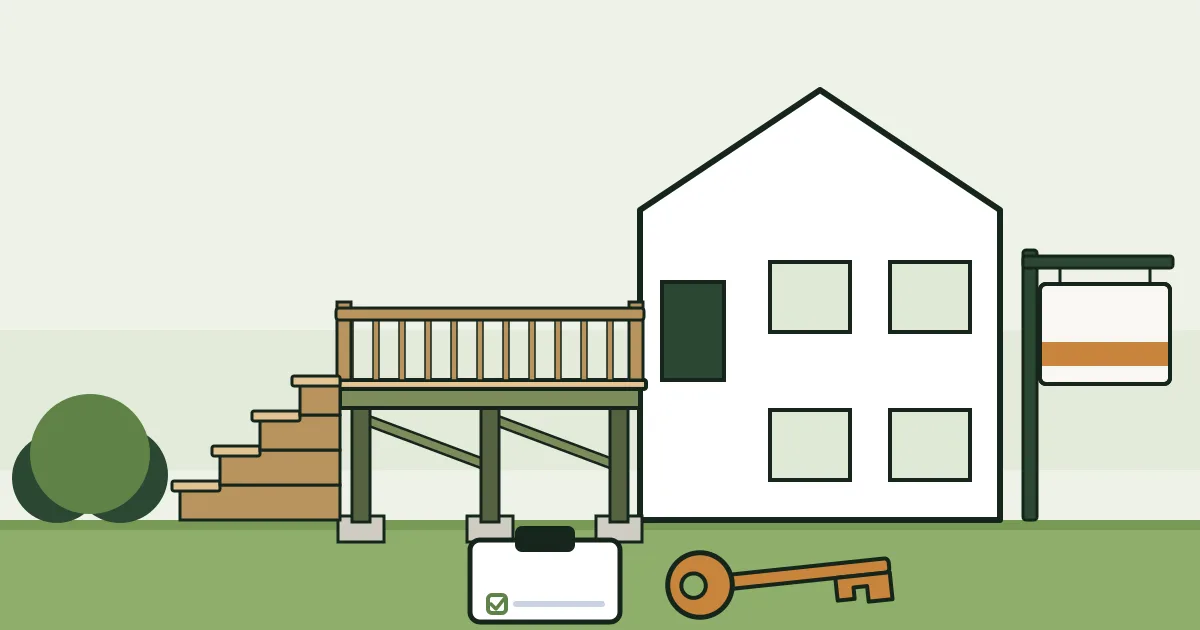
A deck often features in the estate agent's photos as one of a house's selling points. It can be, but a deck is also a structure that has spent years outdoors, and its condition is easy to overlook when you are thinking about kitchens and bedrooms. A rebuild can cost thousands, so a few minutes' attention on a viewing is well spent.
Below: what to look at on the day, which questions to put to the seller, and when it is worth paying a decking contractor to inspect before exchange.
On the viewing
You will not be able to inspect the frame properly, and you should not try to. But you can notice a lot by walking the deck carefully and looking at it from the garden:
- Boards that feel soft, springy or dip, especially near the house, at the edges and around steps
- Dark, crumbly or split timber at board ends, around fixings and at the bottom of posts
- Steps that rock or treads that have come loose
- Rails or balustrades that move, or guarding that looks like garden fencing rather than a proper barrier
- Fresh paint or stain on an otherwise old deck, which can hide problems as well as improve the look
- Air bricks covered by the deck, or a deck surface close to or above the damp-proof course
- Water standing on the deck or against the house wall after rain
- A drain cover or inspection chamber built over with no hatch
Sellers often freshen up a deck before listing a house. A clean, newly stained surface tells you nothing about the joists underneath.
Questions for the seller
- How old is the deck, and who built it?
- Are there any receipts, drawings or details of the boards and frame?
- Has it been repaired, and if so, where and why?
- For a raised deck: was planning permission or building control approval obtained, and is there paperwork?
- Is there any guarantee, and does it transfer to a new owner?
Put the important questions through your conveyancer so the answers are in writing. Missing paperwork is common for older decks and is not automatically a problem, but it is worth knowing about before you commit rather than after.
Raised decks need more attention
Ground-level decks are low risk: the worst outcome is usually the cost of repairs or a replacement. Raised decks are different. Weak footings, missing bracing, decayed posts or inadequate guarding are safety issues, and fixing them can mean rebuilding the structure. Raised decks are also the type most likely to have needed planning permission. The Planning Portal's decking guidance for England explains the factors involved, while Scotland, Wales and Northern Ireland each run separate systems. A deck's existence is not proof it was approved, and keeping its outline in a future rebuild does not settle that question either.
If the deck is raised and you cannot confirm its history, ask your conveyancer how to approach it. If you are planning to replace it with a new raised deck after you move in, our raised decking cost guide shows what a new one is likely to cost.
Will a survey cover it?
A general building survey looks at the house and may comment on the garden and outbuildings, but it may not examine a deck's structure in detail. Check with your surveyor what will and will not be covered. Where the deck is raised, or where it matters to your decision, a decking contractor can inspect it and tell you whether it needs repairs, replacement or nothing at all.
Using what you find
If the deck needs work, a written quote is useful evidence when discussing price with the seller. Our decking replacement cost guide gives indicative figures, and the repair, restore or replace triage shows which of those you are probably facing.
Remember that you can only agree access with the seller's permission, and nobody should open up a deck that is not theirs without it. To arrange an inspection or quote once access is agreed, send an enquiry and say that the property is being bought.
How to look over a deck when viewing a house
- Look from the garden first
Before stepping on the deck, look at it from the lawn for sagging lines, leaning posts and how it meets the house.
- Walk the edges and the house side carefully
Walk slowly near the house wall, the edges and the top of any steps, where decay is most common, and step back from anything soft.
- Check steps and guarding without leaning on them
Look for rocking treads and moving rails, and note whether guarding looks purpose-built.
- Look at the house junction
Check whether the deck covers air bricks or sits close to the damp-proof course, and whether water collects against the wall.
- Photograph what you see
Take photos of anything that concerns you to show a contractor or your surveyor later.
- Ask the seller for the history
Ask about age, builder, repairs and, for a raised deck, any permission or approval paperwork, and pass important questions through your conveyancer.
Frequently asked questions
Can I ask the seller to fix the deck before completion?
You can ask, or negotiate on price instead. A written contractor's quote helps either conversation. Your conveyancer can advise on how to record any agreement.
What if a raised deck never had planning permission?
Raise it with your conveyancer before exchange. They can advise on the options for your situation. Do not assume a deck was approved simply because it has been there a long time.
Is an old deck a reason not to buy?
Rarely on its own. Most decks can be repaired or replaced, and the main question is cost. A raised deck with structural problems deserves more caution because of the safety and approval issues involved.
Ready to talk to a raised decking specialist?
Get Free Quotes →